


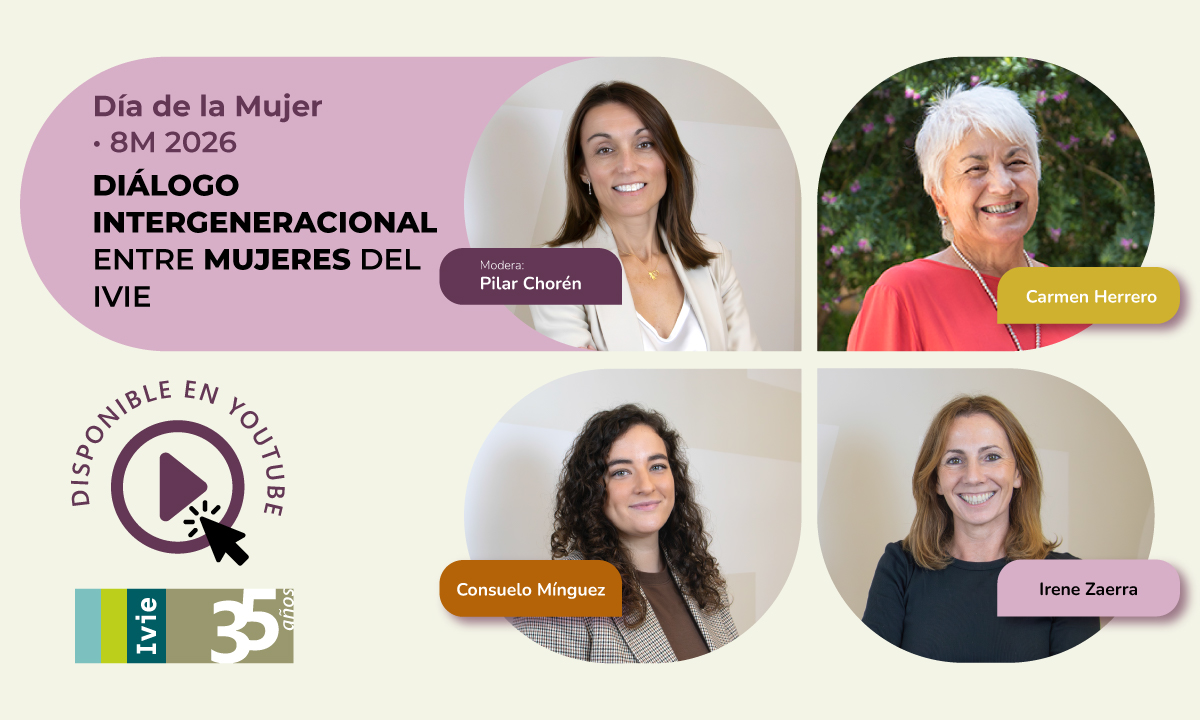
Intergenerational Dialogue Among Women at the Ivie
Drawing on both their personal life experiences and data-driven analysis to reflect on feminism today, Carmen Herrero, Irene Zaera and Consuelo Mínguez engage in an intergenerational conversation, moderated by Pilar Chorén, organized by Ivie to commemorate International Women's Day
To mark International Women’s Day and Ivie’s 35th anniversary, the Ivie brought together women from different generations for a three-way dialogue. Together, they shared their personal experiences as well as statistical evidence drawn from their research careers, reflecting on how the situation of women has improved in recent years and how much still remains to be done to achieve full equality.
In this open and sincere dialogue, Carmen Herrero, Consuelo Mínguez and Irene Zaera, moderated by Pilar Chorén, reflect on equality in areas such as education, employment and private life. Their own experiences are combined with data to analyse gender bias, differences in the distribution of household chores and even the anti-feminist shift observed among some groups of young people.
Generation differences among them can be observed from an early stage of life in many areas. For example in education, Carmen recalls her experience as one of the few women who managed to attend university at a time when female participation was limited. She chose mathematics—a STEM degree—despite her family’s disapproval. “Throughout my entire degree, I never had a female professor; they were all men. At that time, science degrees had no female faculty members and hardly any female students,’ she mentions.
This contrasts with Irene and Consuelo’s experience as they never felt discouraged or steered in their educational path or access to university. However, all three agree there is still a certain sociocultural bias that limits women’s scientific vocations. Although women now account for 57% of total university enrollment, they represent only 35% of students in STEM degrees. “According to a study by EsadeEcPol, by age 10, girls already perceive themselves as less capable than boys in mathematics and are less likely to choose it as their favourite subject”, explains Irene.
Regarding the labor market, all three agree that significant progress has been made in recent years, with women entering the workforce outside the home. However, they also point to areas where improvement is still needed. “There is still a wage gap, as women earn 7.5% less per hour worked than men, and more than 21% of employed women work part-time, compared to 7% of men, which is closely linked to work-life balance. In addition, women face higher unemployment rates (11.9% vs 9.3%) and they exceed men in long-term unemployment (33% vs 29%). These gaps tend to become more pronounced at retirement”, Consuelo explains. 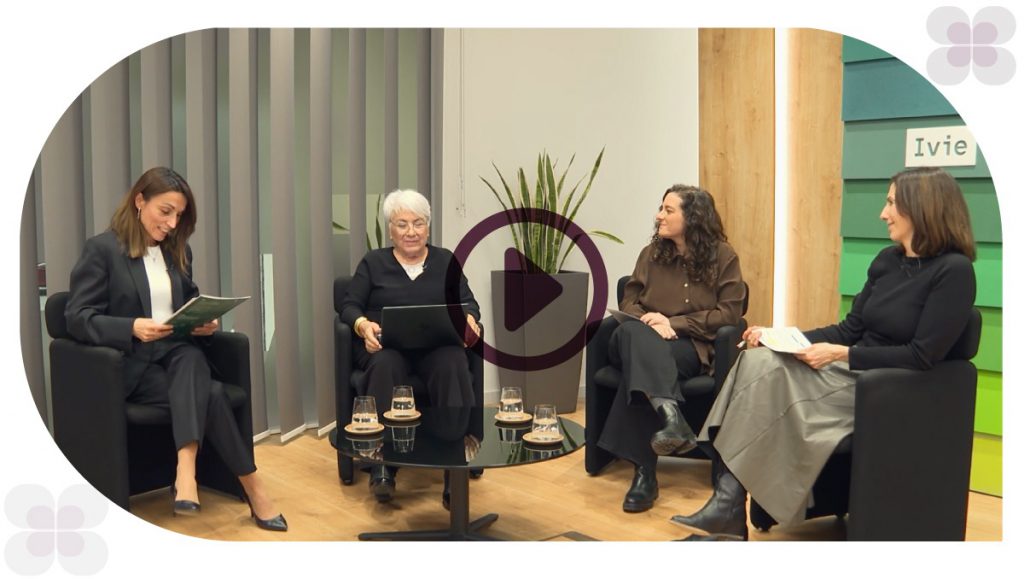 The dialogue also addressed equality in more private spheres, such as household tasks and childcare. During the conversation, they agreed that task-sharing has become more common in many homes. Although statistics show that women still spend more time than men doing domestic work and childcare, which in practice results in a double workday.
Irene pointed out that motherhood continues to be a turning point in women’s careers. Despite legal advances in recent years, such as equal maternity and paternity leave, inequalities still persist, for example, in the use of unpaid leave or part-time work, which continues to fall mainly on women.
They also discussed the impact of these responsibilities on mental health, with higher levels of stress among women due to the so-called ‘mental load’ of managing the home and family life. In this regard, they insisted on the need for a behavioral change in both men and women to achieve a more balanced distribution of responsibilities.
The dialogue also highlighted cultural setbacks and misinformation among some young people regarding feminism, which is sometimes openly rejected. In response, the participants emphasized:
- The importance of educating children on equality from an early age, both at school and at home
- The need for female role models, not only public figures, but also women close to home
- The value of stepping forward and making women’s contributions visible, as well as strengthening alliances with men at home and in the workplace
- The fundamental role of support networks among women
In short, the event offered an honest, intergenerational conversation that invites to discussion on the progress made and challenges that remain. As the participants reminded us, equality is not a privilege, but a right.
